




HONG KONG — China’s economy last quarter grew at the slowest rate in three years, reflecting a broader slump that the country’s leaders signaled earlier this year when they set the lowest growth target in more than three decades.
On Wednesday, the National Bureau of Statistics said the economy expanded by 4.3% in the second quarter, compared with a year ago, down from a 5% pace in the first quarter and short of economists’ expectations.
Although China’s factories are churning out chips and electric cars to supply a global boom in artificial intelligence and energy-saving products, many Chinese people are feeling squeezed at home.
A long-running property crisis has no end in sight, with steep declines in development activity dragging down economic growth. Jobs outside of factories are hard to come by and paychecks are not growing. Retail sales of consumer goods have been choppy. They fell in May, for the first time since the end of COVID-19 lockdowns in late 2022, before recovering somewhat in June.
That is in stark contrast to China’s relentless strength in manufacturing and trade, with a government report released Tuesday showing China’s exports surging by 27% in June compared with a year earlier, driven by shipments of chips, batteries and cars. China’s trade surplus in June, at more than $125 billion, was the second largest on record. In the first half of the year, the value of China’s exports grew by more than 20%, the data Wednesday showed.
For economists, the latest numbers are another indication that China’s mighty export machine is masking weaknesses elsewhere.
“You get this AI boom, which is a global thing, and China is part of the leading nations on the frontier,” said Yu Song, the chief China economist at UBS Securities. “Without this, China’s economy would be in a much worse state.”
When measured on a quarter-to-quarter basis, China’s economy expanded by only 0.9% in the second quarter. When projected out for a year, the second-quarter data implies that the economy was growing at an annual rate of 3.6%, sharply down from a pace of more than 6% in the first quarter.
The second-quarter annualized rate also missed official targets. Shortcomings in China’s economic growth drivers prompted the ruling Communist Party this year to set the lowest annual growth target in decades, with a goal of between 4.5% and 5% this year.
The effects of the war in Iran have put an extra squeeze on Chinese households, with rising fuel prices prompting them to drive and fly less, at a time when many were already worried about the economy and choosing to save more.
China has softened the blow of rising fuel costs by controlling the price at the pump, but the cost of filling up for drivers is still double-digit percentages higher than a year ago.
One silver lining, economists said, was that rising fuel prices started to feed through to broader inflation in the quarter, reversing a problem that China has struggled to shake: more than three years of a broad-based decline in prices. Such deflation tends to chill spending, with consumers putting off purchases in expectation that prices will be lower in the future.
China’s gross domestic product deflator, a broad measure of prices across the economy, was negative in 13 of the past 14 quarters — the most protracted slump on record. But it turned positive in the second quarter.
For China’s leadership, the question now is: what to do next? Li Qiang, China’s premier, told a group of entrepreneurs this week that officials were focusing on new drivers of consumption and ensuring job stabilization.
“It is important to take a comprehensive and objective view of the current economic situation, fully recognizing the achievements made while remaining clear-eyed about the problems,” said Li, according to state media, which ran a story about the meeting on the front page of the official People’s Daily.
Some economists anticipate a discussion of fresh stimulus measures at a meeting of top policymakers later this month. On Monday, China’s top economic planner announced a plan to target $8.85 trillion of annual retail sales by 2030, implying a 20% rise from last year.
Beijing has also promised to raise wages and increase household consumption as a share of the economy. It is around 40%, significantly lower than the 60% share of gross domestic product for most developed countries.
But analysts said these goals are not particularly ambitious. And stubbornly reluctant consumers in China show few signs of opening their wallets.
Online shoppers are sharing tips on how to scrimp and save, rallying around the motto to “save where you can, spend where you must.”
Users have shared tips about “shopping cart cooling-off periods,” or leaving nonessential items in carts for three days before deciding to buy them. (The practice is a wry nod to the officially enforced “cooling-off period” for couples seeking divorces.)
Others push to replace foreign cosmetic brands with cheaper local alternatives and to substitute skin care products with baby lotion. “Buy what’s right, not what’s pricey,” a user on the social media network Weibo posted recently.
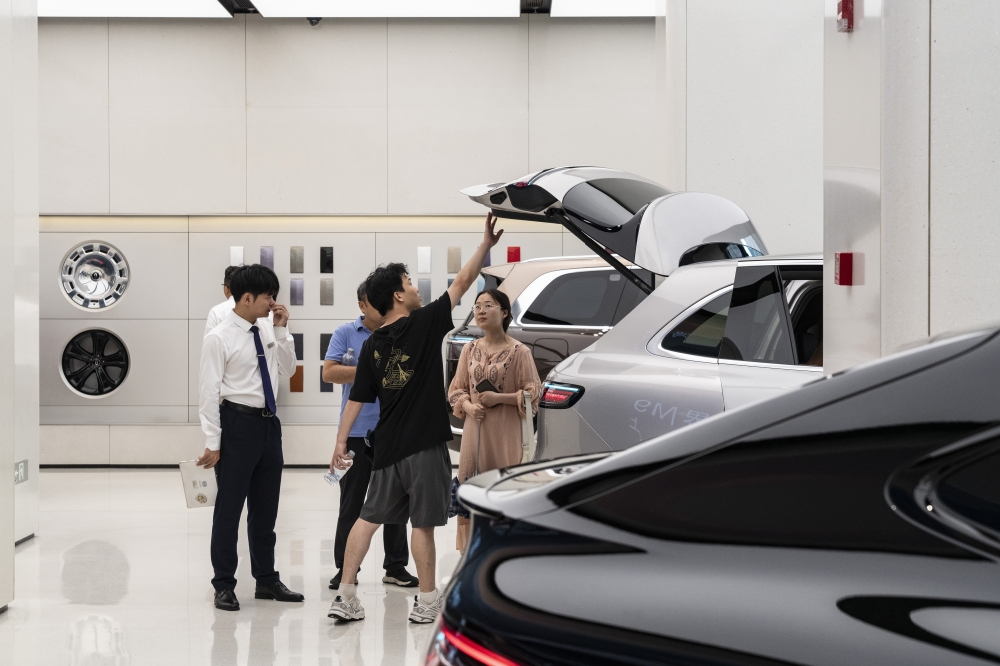
All the while, prices have continued to fall for products as varied as cosmetics and automobiles. For categories like cars, the recent plunge has been accentuated by the end of a policy to incentivize purchases.
Since a devastating property crash, Chinese policymakers have tried to replace the growth generated by the real estate sector with more robust consumer spending. They rolled out huge subsidies for households to trade in old cars, home appliances, and phones from 2024 through last year.
While it generated some activity, the policy failed to address the plummeting value of property, where most household wealth is concentrated. Now, economists say, China is in a “payback period” following the jump in policy-induced sales.
As the economy splits between the relatively few who benefit from China’s role in the global AI boom and the rest, the divide is having a profound impact on the country’s social fabric.
It has accentuated the class split between “those that benefit from the boom in their talents, well-protected jobs and wealth versus those that are fully or partly replaced by AI,” according to economists from Nomura, a Japanese bank.
China’s property bust has led to more than 14 million people losing construction jobs. Many of those workers bought apartments in smaller cities, far from the pockets of %-generated wealth that may revive parts of the property market.
“For China, the issues are that it wants to make sure it is still at the frontier,” Song said. “You want the benefits to be more widely shared so that you don’t leave too many people out.”
The AI boom “doesn’t benefit ordinary people in China because this priority, the industrial focus on high tech and semiconductors, actually causes structural unemployment and underemployment,” said Dan Wang, the China director at Eurasia Group, a consulting firm.
What’s more, Wang said, disposable income growth is now lower than economic growth. If that continues, she noted, “that means the national income is skewed in distribution toward government and companies, and not consumers.”
This article originally appeared in The New York Times.
Oman Observer is now on the WhatsApp channel. Click here